How to choose the right carrier: 6 things to ask
When a company chooses a carrier, the decision often comes down to a single number: the price per shipment or per kilometre. That's understandable, but misleading. Price certainly plays a role, but the lowest quote can end up costing more once you factor in delays, claims, or costs that weren't in the original calculation. The following criteria sum up what to ask and what to look out for before you entrust someone with your goods.
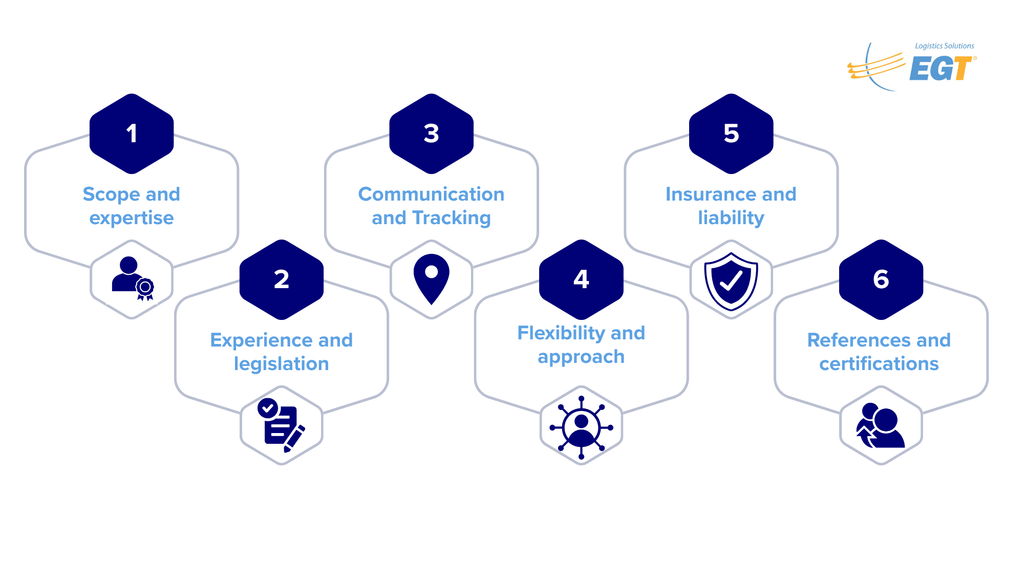
1. Scope and specialisation of services
The first question is whether the carrier covers everything you need at all. Can they handle road, air, rail and multimodal transport, or will you have to combine several carriers and keep track of where one's responsibility ends and the other's begins? The more links in the chain, the more places where something can go wrong.
Specialisation in your destinations matters just as much. Transport to neighbouring Germany and transport to, say, Kazakhstan are two different worlds, with different legislation, different routes and different risks. OOn paper, almost every carrier offers a route abroad. The difference lies in whether they actually operate there regularly or only handle that country occasionally, and whether they have someone on the ground you can turn to, or rely on an unfamiliar partner at the other end of the phone. It pays to look for a partner who genuinely knows the region and, ideally, has a branch there.
One of the most important criteria for the scope of services is often hidden: does the carrier have its own fleet and technical infrastructure, or does it subcontract part of its orders to other carriers? Both approaches have their own logic.
- A carrier with its own fleet has full control over who is carrying your cargo and in what condition. If something becomes complicated along the way, it acts on its own behalf, not through several intermediaries. Capacity is limited here, though, so during peak periods the carrier may turn your order down.
- A broker can find an available vehicle almost any time, since it draws on a wider network of carriers, but that comes with greater risk. If a company doesn't thoroughly vet its subcontractors, your shipment could end up with a carrier your original partner has never even met, or, worse, with a fraudster posing as a carrier.
2. Experience with customs administration and the destination country's legislation
For exports outside the European Union, customs is where things are really put to the test. The carrier needs to know the specifics of the country in question:
- the documentation required,
- current sanctions regimes,
- the licences needed,
- how the customs procedure works.
A single missing field or an incorrectly issued document means a delay at best, and confiscation of the goods at worst. Underestimating this side of things doesn't pay off. So find out whether the carrier has its own team to handle customs clearance, and how it manages documentation for your specific destinations.
3. Communication and shipment tracking
A shipment in transit raises questions: where exactly is it, will it meet the deadline, what happens if there's an unexpected complication. Notice how quickly and clearly the carrier communicates even at the enquiry stage. If responses are slow before you've even signed a contract, they won't get any better afterwards.
You should also find out whether you'll have a single point of contact who knows your shipments, or whether you'll have to speak to someone different each time and explain the situation from scratch. Repeatedly explaining the background is impractical and slows things down. In the end, that can mean delays.
Make sure you'll be able to track your shipment. Clear information about its current status isn't a luxury but a standard that significantly reduces stress. When you know where your goods are, you can plan the next steps and pass on any changes in good time. A transparent carrier will give you this information without you having to chase it. So ask how you'll be kept informed about the status of your shipment, and whether you'll be able to see its location for shipments outside the EU too, where tracking tends to be more difficult.
4. Flexibility and an individual approach
Every company naturally has slightly different needs. Even so, you may come across a carrier for whom you're just another number in the system: a standard process, with no room for individual differences. Yet it's precisely the ability to adapt to a client's specifics, the size of the order and the nature of the goods that often determines whether a partnership works in the long run. Find out how willing the carrier is to build a solution tailored to your needs, rather than pushing you into a single template.
5. Insurance and liability for the shipment
Ask before the worst happens:
- What happens if the goods are damaged or lost?
- Does the carrier have insurance in place with clearly defined liability, or would you bear any resulting loss yourself?
Have the scope of cover and the conditions for making a claim explained to you before you sign the contract. Once a loss has occurred, it's too late to negotiate. Especially for higher-value shipments or sensitive goods, it's worth checking what value the shipment is covered up to, and what, conversely, is excluded from the insurance.
Standard CMR liability only covers a limited amount per kilogram of the shipment's weight, regardless of the actual value of the cargo. For higher-value goods, this can leave a noticeable gap between the compensation paid out and the actual loss. In such cases, we recommend one of the levels of all-risk insurance, since CMR liability alone might not cover the actual value of the shipment in the event of a loss.
6. References and certifications
General statements about reliability sound nice, but they don't prove anything. Concrete experience with a company of a similar size or from a similar industry will tell you far more. So don't be afraid to ask for references and case studies; a reputable carrier will be happy to provide them. If they avoid specific names and figures, that in itself is an answer. Go through the carrier's references and case studies and ask about projects similar to yours.
Certifications are another objective indicator of credibility, since they're based not on promises but on independent verification. Certifications aren't a legal requirement for carriers, so by no means every one holds them. If a company does, it's a signal that it has passed an audit and has controlled processes in place. ISO standards confirm established processes in the areas of quality, environmental protection and occupational health and safety.
Warning signs to watch for, and a checklist to tick off before choosing a carrier
Some things should raise a red flag well before you get to the contract stage:
- An unclear or incomplete scope of services.
- No references, or no willingness to provide them.
- Little or no experience with your specific route or destination.
- Slow and evasive communication even at the enquiry stage.
- An inability to adapt the service to your specific needs.
One such sign on its own may not mean much, but several together are good reason to keep looking. And before you make your final decision, go through this short checklist:
- Does the carrier cover all the types of transport I need, and specialise in my destinations?
- Does it operate its own fleet?
- Can it handle the destination country's customs administration?
- Will I have a reliable contact and fast communication?
- Will it adapt to the size and nature of my company?
- Can it provide references and certifications?
- Does it have insurance and the option to track shipments?
The more answers come out as "yes", the lower the risk of unpleasant surprises. At EGT Express, we meet all of these criteria: from our specialisation in eastern markets, through our own fleet, technical infrastructure and customs department, to our ISO certifications. With us, you'll find all types of transport under one roof, so you don't have to piece together a solution from several companies. We approach every customer according to the nature of their business and build a tailored service around them. Every shipment has its own freight forwarder you can turn to with anything, from a route query to resolving an unexpected situation. You can also track your shipment online.
We offer much more. Discover all the options
We have our own fleet of several dozen vehicles for different types of cargo, including ADR, refrigerated and pharmaceutical transport, ranging from vans through curtain-siders and box trucks to lorries and oversized transport. We also work with partners, so even when our own fleet is fully booked, we can respond quickly to enquiries without compromising on quality. Our membership of FIATA and WCA also gives us access to a vetted network of partners around the world.
We also operate a regular air freight line from Ostrava, where we have our own branch and warehouse right on the airport premises. Transport can also be complemented with rail or sea connections, which is particularly useful where a combination of speed, capacity and price is required.
As part of our complete logistics solutions, we also offer warehousing. We provide both short-term and long-term storage, including services such as transhipment, consolidation, cross-docking and temperature-controlled storage. We can also arrange additional cargo insurance for you, so-called all-risk insurance. That means you can stay at ease even when transporting high-value goods, since any resulting loss will be reimbursed by the insurer.
We have local representation in our destinations, which allows us to respond quickly and provide comprehensive support right at the place of delivery. Last but not least, we place great emphasis on the environmental standards of our fleet. All our vehicles meet the Euro 6 emissions standard, are on average no more than two years old, and are maintained at official service centres. Our qualified drivers also follow fuel-efficient driving principles to minimise fuel consumption and maximise the reduction of carbon emissions.
Join 25,000+ satisfied customers
Every year, we cover approximately 4,953,338 kilometres and deliver 154,791 shipments. Get in touch with us and experience reliable international logistics without borders. We'll be happy to prepare a no-obligation quote and a tailored consultation for you.